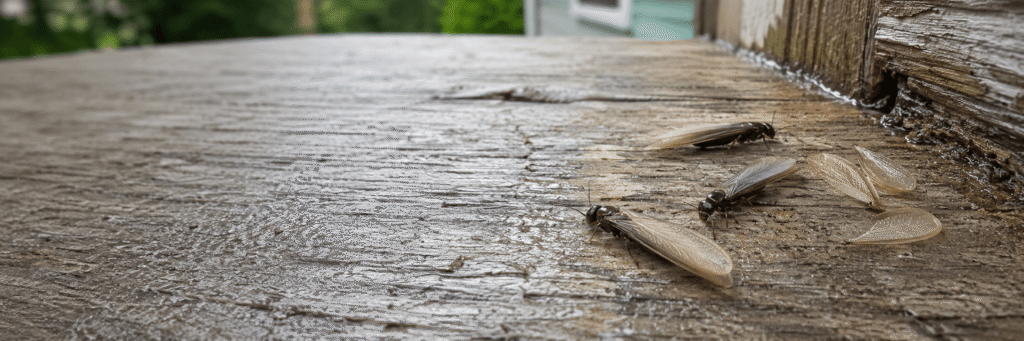
Bent antennae, a pinched waist, and uneven wings point to a flying ant. Straight antennae, a broad waist, and 4 equal-length wings point to a termite. Here is how to check each feature and decide what to do next.
How can you tell a flying ant from a termite?
Winged ants and termites often appear with little warning. One afternoon the house looks normal. A few hours later, insects are collecting at a window or discarded wings are scattered near a door. Both insects send out reproductive adults to start new colonies, so the timing and behavior can look remarkably similar.
Identification matters because the next step is different. A flying ant may point to a nearby ant nest, while a termite swarmer can be evidence of a colony feeding inside or beneath the structure. Color alone is not reliable. Depending on the species, both can be dark brown, black, tan, or amber.
The Fastest Way to Compare Flying Ants and Termites
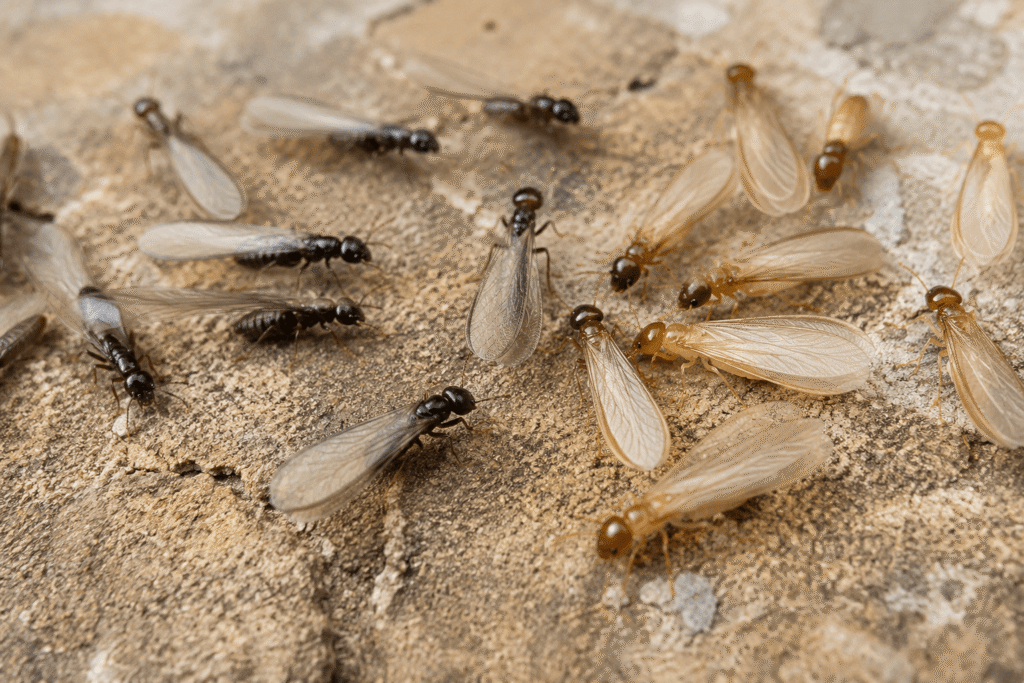
The most reliable identification comes from looking at the antennae, waist, and wings together. One feature can be difficult to see in a photograph, especially when the insect is moving or the wings overlap the body. Two or three matching features provide a much stronger answer.
Start With the Antennae
Ant antennae have a distinct bend that looks like an elbow. The first section extends from the head, then turns before reaching the tip. Termite antennae extend forward without that sharp joint and often resemble a short string of beads. This is one of the most dependable differences, especially when the insect’s wings overlap its body.
Compare the Waist and Body Shape
A flying ant has the familiar segmented ant shape: a broad chest, a tight waist, and a rounded abdomen. The narrow connection between the chest and abdomen is usually visible from above. A termite has a more uniform body. Its chest and abdomen meet without the deep pinch seen on an ant, giving the middle of the insect a thicker, almost rectangular shape.
Check the Wings While They Are Still Attached
Both insects have 2 pairs of wings. On a flying ant, the front pair is noticeably longer and broader than the rear pair. A termite’s 4 wings are close to equal in length and extend well past the end of its body. Termite wings also detach easily, so this clue may disappear soon after the swarm lands. When only loose wings remain, compare several of them rather than relying on one damaged wing.
Do Not Rely on Color or Size Alone
Color is one of the least useful clues. Flying ants and termite swarmers can both appear black, brown, amber, or tan, depending on the species and lighting. Size also overlaps. A large winged ant is not automatically a carpenter ant, and a small swarmer is not automatically harmless. Body structure provides a more dependable identification than color or length.
Why Flying Ants and Termites Appear at the Same Time
The winged insects are reproductive members of an established colony. Their job is to leave, pair up, shed their wings, and start another colony. Warm temperatures, moisture, and still air can trigger many insects to fly within a short period. Porch lights and bright windows then draw them into the same visible areas.
A swarm may last only a few minutes, which is why the insects can vanish before anyone gets a close look. The wings, emergence point, and number of insects left behind can be more useful than the swarm itself. Note where they appeared before vacuuming them up.
What Discarded Wings Can Tell You
Termite swarmers twist off their wings after landing. Matching wings may collect on windowsills, around sliding doors, near baseboards, or below a small opening in trim. Ants also shed wings, so wings alone do not confirm termites. A pile of equal-sized wings combined with broad-bodied insects makes termite activity more likely.
Flying Ants Are Not Always Carpenter Ants
The presence of wings tells you that the ant is a reproductive adult, not which ant species it belongs to. Many common ants produce winged adults. Carpenter ants are larger than many household ants and can nest in damp or damaged wood, but their presence is confirmed through the insect’s physical features and nesting evidence. A winged ant should not be labeled a carpenter ant based on size alone.
What an Indoor Swarm Means
A few winged insects outside near a porch light can come from a colony elsewhere in the neighborhood. Insects emerging inside deserve closer attention. Watch for swarmers coming through a wall joint, window frame, ceiling opening, baseboard, or gap around plumbing. That emergence point may sit close to the colony or a concealed travel route.
Subterranean termites live in the soil and may enter through foundation cracks, utility openings, or mud tubes. Drywood termites live within the wood itself and do not need contact with soil. Correct identification helps narrow the inspection area and determines which signs matter next.
When Termites Swarm in Sacramento
Sacramento’s termite swarms do not all follow one calendar. Subterranean termites often fly on mild days after rain, commonly during spring or fall. Drywood termite flights are more common on warm days from late summer into fall. Weather can shift those windows, so an unexpected month does not rule termites out.
What to Do After Finding Winged Insects
Save a sample
Place several insects and loose wings in a sealed bag or small container. Avoid crushing the antennae and body.
Photograph the details
Take close-up photos of the insect from above and the side when possible. Try to capture the antennae, waist, and wings, along with any loose wings or the point where the insects appeared.
Record where they appeared
Write down the room, nearby window or wall, time of day, recent weather, and whether the insects emerged from a specific opening.
Check the nearby area
Look for discarded wings, mud tubes, dry pellets, small holes, or damaged wood. Do not open walls or disturb a suspected entry point.
Schedule an inspection when needed
Indoor termite swarmers, repeated activity, or insects you cannot identify warrant a professional termite inspection.
Flying Ants vs. Termites, Answered
Look at the antennae and waist. Flying ants have bent antennae and a narrow, pinched waist. Winged termites have straighter, bead-like antennae and a broad body with little narrowing between the chest and abdomen.
Yes. Both are reproductive insects that shed their wings after a mating flight. Termite wings tend to detach easily and may collect in matching piles near windows, doors, lights, or baseboards.
Not always. A few flying ants can enter from outdoors, especially around lights. Repeated indoor activity, large numbers emerging from one location, or ants coming from a wall void can indicate a nearby nest.
One termite outdoors does not prove a structural infestation. Winged termites emerging indoors, coming from a wall or trim opening, or leaving many discarded wings inside should be inspected because the source may be within the building.
Subterranean termites commonly swarm after rain when temperatures are mild, often during spring or fall. Drywood termites are more likely to swarm on warm days from late summer into fall. Exact timing changes with weather and termite species.
Save a few insects before cleaning or spraying. Place them in a sealed bag or small container and take clear photos. A sample makes identification easier and helps an inspector locate where the insects emerged.
Technical references: Identification and swarm timing were reviewed against guidance from the University of California Statewide Integrated Pest Management Program.